View Categories

Form Confirmations

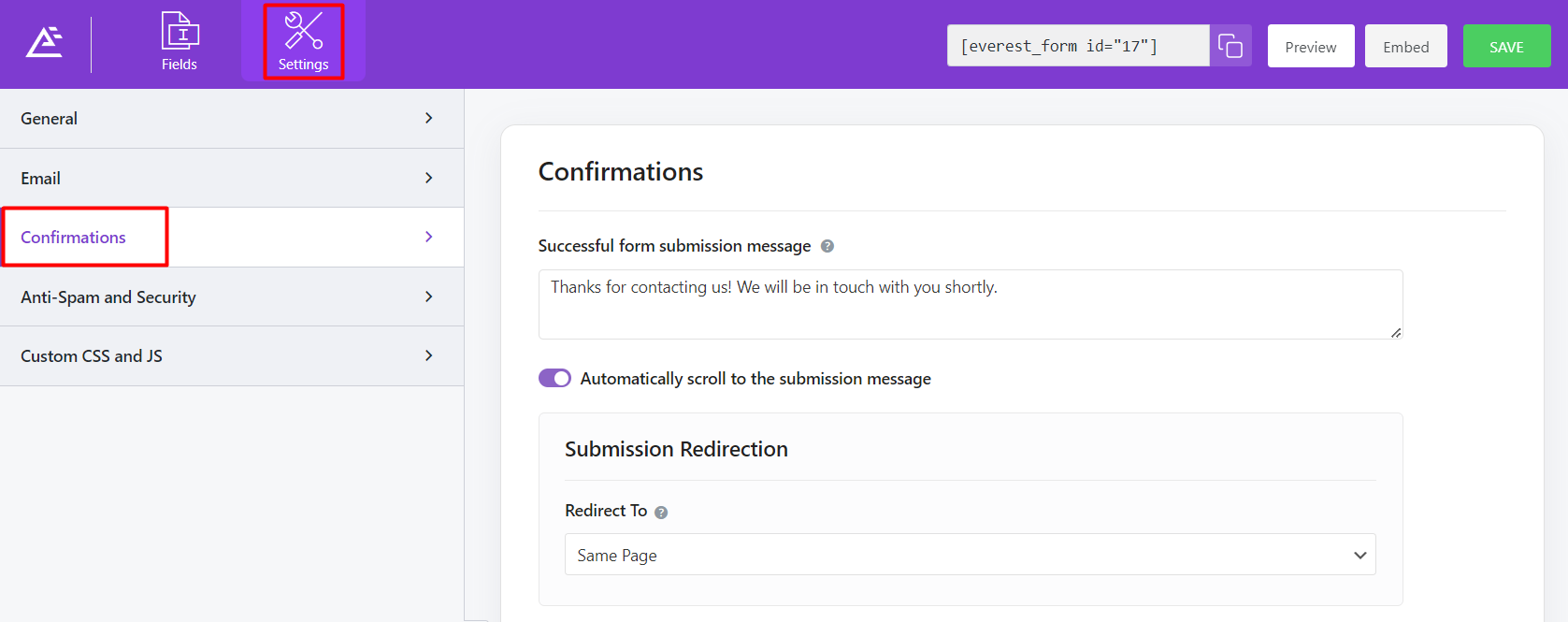
The Confirmation settings in Everest Forms allow you to control what happens after a user successfully submits your form.

Confirmation Settings for Everest Forms

Form Confirmation Types #

From here, you can choose how users will be redirected or what they’ll see after form submission:

1. Same Page (Default) #

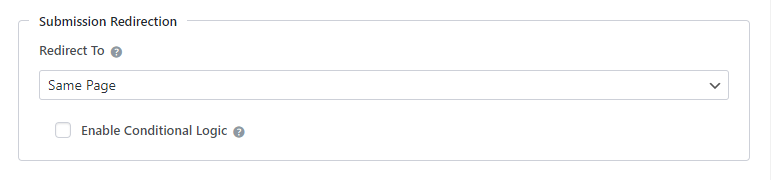
The behavior is that users remain on the same page with a success message. It is best suited for simple contact forms and newsletter sign-ups.

Same Page Settings

Setup for Same Page Confirmation

  • Success Message: From here, you can customize the default success message.
  • Auto scroll to Submission Message: Enabling this will automatically scroll the page to display the success message.
  • After Submission Form Behavior: Control what happens to your form after successful submission. Choose between these two options:
    • Reset Form: Clears all field values for new submissions.
    • Hide Form: The form disappears, leaving only the success message visible.
  • Show User Submitted Form Summary: If you choose Hide Form, you can enable this option, which displays a summary of submitted information to users.
    • Preview type: Choose how the summary of the submitted form appears. You can choose between Basic, Table, or Compact.
  • Display Message: Choose where to display the success message of the form submission. You can choose between the Above Form Summary, the Below Form Summary, or as a pop-up.
Example of Same Page Form Confirmation
Example of Same Page Confirmation Type with Form Summary Enabled

2. Redirect to Custom Page #

Users are automatically redirected to a specific page of the site when you choose this confirmation type. It’s best for Lead generation forms and registration forms.

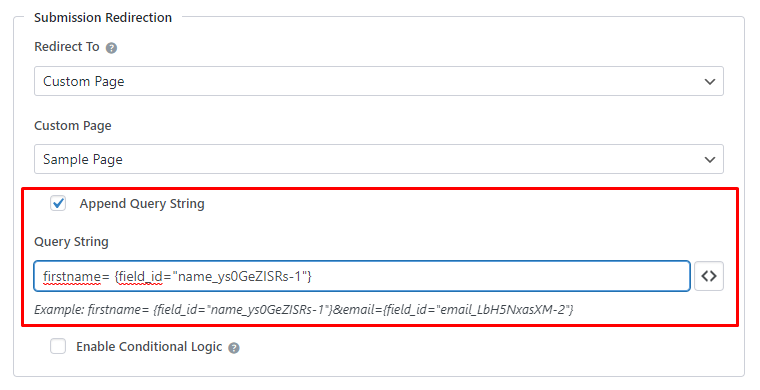
Redirect to Custom Page Settings

Setup for Redirecting to Custom Page

  • Custom Page: Select any published page from your WordPress site using the drop-down.
    Use Cases:
    • Thank you, pages with additional information.
    • Download pages for lead magnets.
  • Append Query String: Enabling this option will allow you to pass form data as URL parameters when redirecting users to a custom page after form submission.

3. Redirect to External URL #

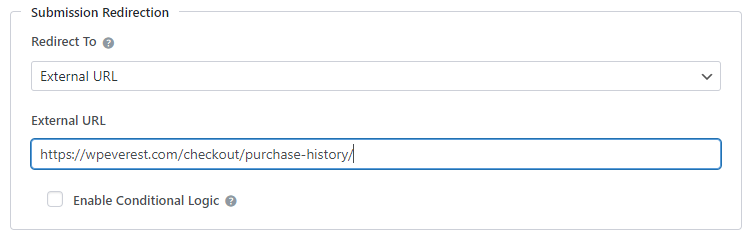
Users are redirected to any external website through this setting. Its best use case is when you want to integrate with external services.

Redirect to External URL Settings

Setup for Redirecting to External URL

  • External URL: Enter the complete external URL (including https://). It also has the option to enable Open in new tab, which opens the external URL in a new tab, and Append Query String.
Note: The WordPress reserved strings can't be used for appending via Query Strings. For more details, visit https://developer.wordpress.org/reference/functions/register_taxonomy/

Conditional Logic #

Conditional Logic allows you to create different confirmation experiences based on user responses. This powerful feature enables personalized user journeys after form submission.

Toggle “Enable Conditional Logic” to enable. You’ll then get the“Conditional Confirmation” section with “Active” status.

Enable Conditional Logic in Form Confirmation

Conditional Confirmation Settings #

First, you need to choose between the confirmation type, as we did in the above section.

  • Confirmation Type: After you’ve chosen the confirmation type, again select the same type to use the conditional logic. Choose between Same Page, Redirect to Custom Page, or External URL.

Next, you can add conditional rules for the selected confirmation type. You can also add multiple rules using AND or OR logic. When the conditional logic is enabled, the confirmation will function according to the rule set.

For more details, read our documentation on how to setup Conditional Logic for redirection after form submission. 

Save the settings to let users experience the confirmation setting that you’ve configured.

Additional Resources #

Powered by BetterDocs

Scroll to top